
Back
Unifying Forrester’s Service Model
I orchestrated a cross-functional design sprint to bridge the gap between high-touch analyst advisory and digital self-service, transforming a disjointed client experience into a unified, retention-driving service model.

impact
Alignment
Unified cross-functional teams around a shared service model and vision to deliver continuous client value.
+12%
Retention rate increase via the new service model.
+3.1 Point Increase
In overall CX Index score (2022–2024), validating long-term impact.
The "Invisible Value" Problem
Forrester’s primary value lies in the expert guidance that its analysts provide. However, the digital client platform acted merely as a library for reports. Clients had high-touch engagements with analysts, but the digital platform didn't build on those key moments. It also did not demonstrate the value delivered during them.
Because of this disjointed experience, clients’ perception of the value Forrester provided ebbed and flowed. The result, they engaged less frequently leading to higher churn.
We needed to transform the service model and platform to provide a more seamless experience. One in which clients could easily pick up where they left off following a conversation with one of Forrester’s analysts and take action on the guidance they were given.
Orchestrating a Design Sprint to Align Leaders Across the Org
To solve a problem this structural, I recognized we needed to convene leaders from across the organization. Gaining that level of alignment to co-create a solution required dedicated time, focus, and customer feedback.
Having successfully orchestrated Design Sprints in the past I knew applying this proven methodology from Google Ventures to our problem would help us solve it quickly.
I pitched my idea to hold a sprint to different leaders across the organization. I shared examples that demonstrated how other organizations experienced success with sprints and highlighted how it would accelerate disparate projects that were already taking place. With enough buy-in I was able to book three days in-person (for high energy co-creation) and two days remotely (for focused prototyping and testing).
Accelerating Consensus Within 48 Hours
Within the first two days, I was able to get the sprint team which consisted of stakeholders across Research, Sales, Product, and Technology to develop a shared understanding of the problem and agree on a definition of client success.By day three, the team generated a litany of solutions, but with clients scheduled for testing by the end of the week we needed to pick one final idea to prototype and test. I led a voting exercise and a concept nicknamed “The Journey To Success” was the clear winner. It was now my direct team’s responsibility to build a prototype and develop a study plan for testing with clients the following day.
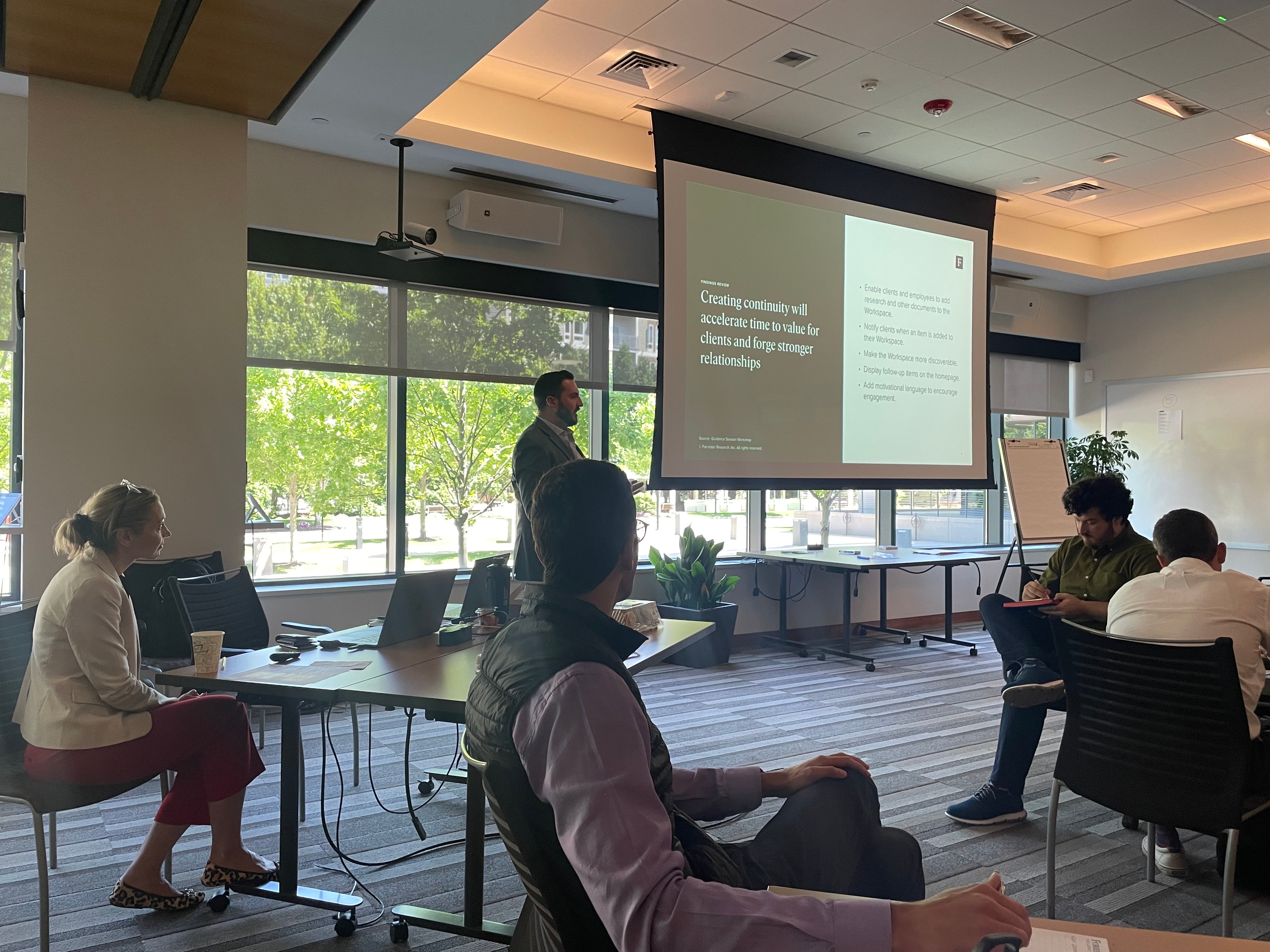
During day one I shared findings from past research to form of a collective understanding of the problem.
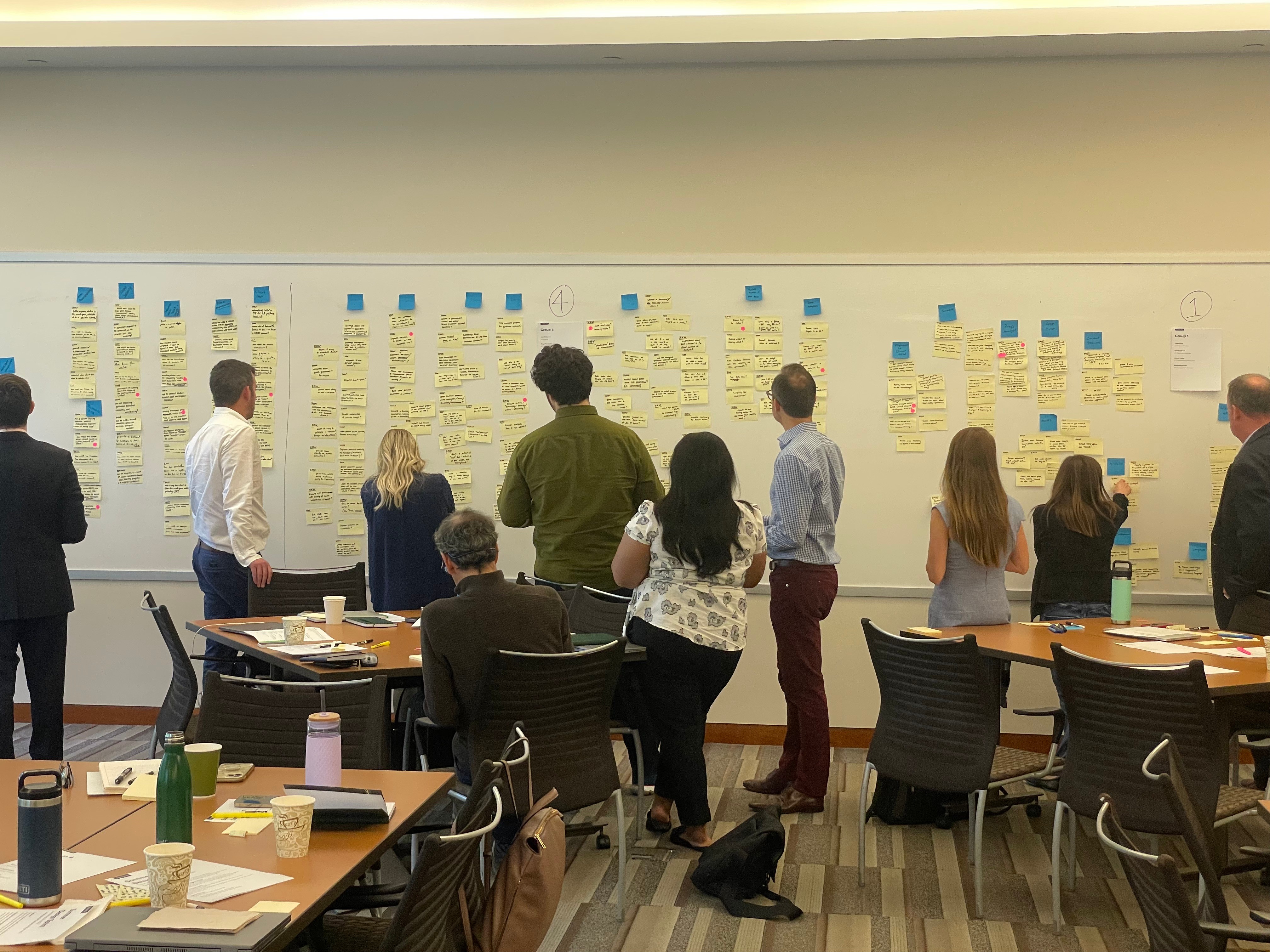
During day two sprint participants affinity mapped “how might we” questions identifying where there were similar opportunities to solve the invisible value problem.
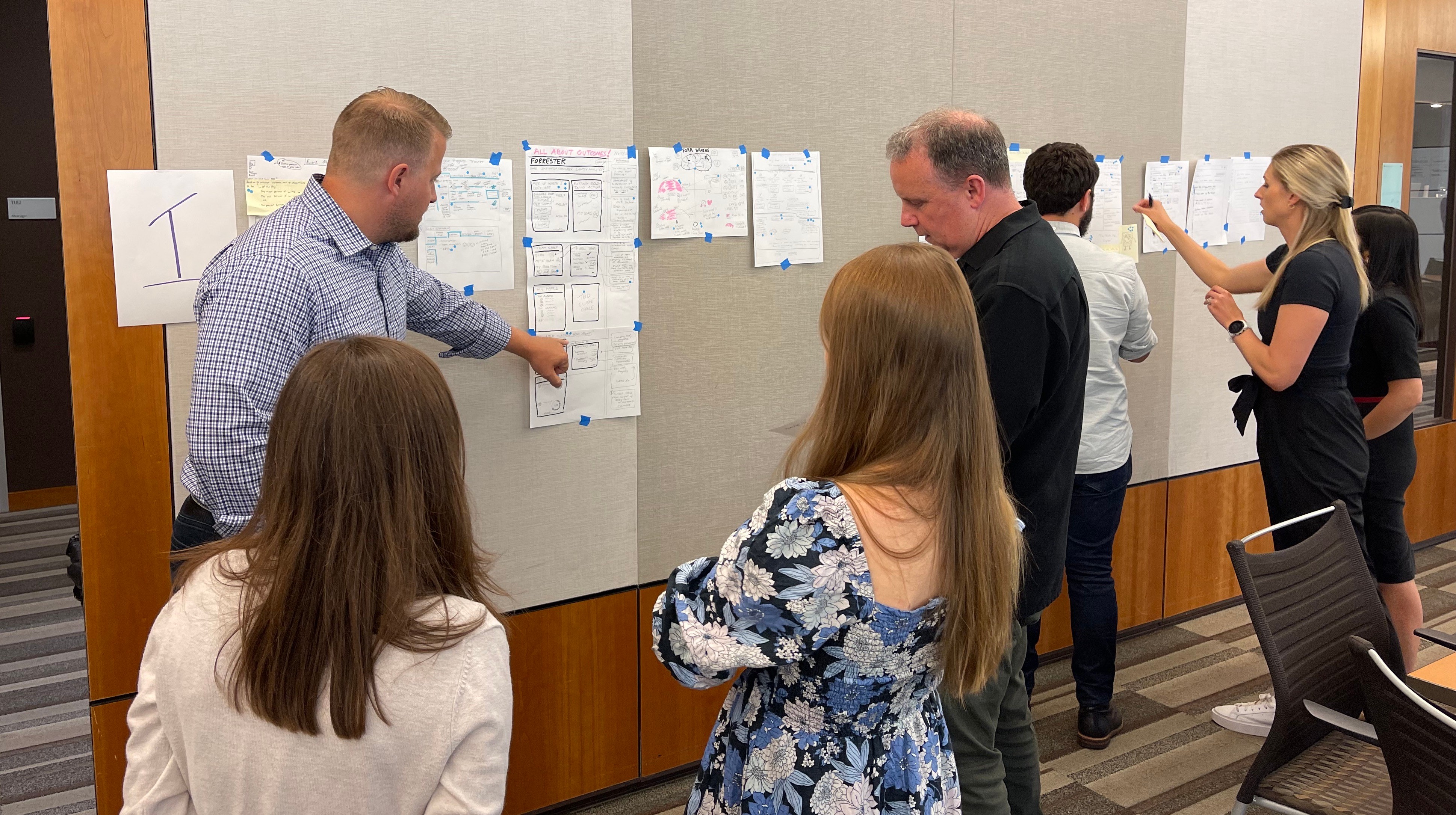
On day three participants reviewed each others solution sketches. They identified areas of interest using small sticky dots and then cast their final votes using large ones.
Evolving Beyond the Report and Focusing on Clients Initiatives
Testing validated that clients didn't want more reports, they wanted a research partner that could proactively guide them through their initiatives.
“I do feel like if I was moving towards an objective driven engagement that would be a benefit. That would be something new that I'm not currently doing with Forrester. I’m doing it, but it’s not organized in that way.”
– VP of Marketing at a Technology Company
This breakthrough and validation from clients created a unified vision for how we could transform our service model and enhance our digital platform. Putting our clients’ initiatives at the center was the answer.
When an analyst advises a client, we would build on that key moment. A client would be notified via email that their dashboard (a new area of the digital platform) was updated with that analyst’s guidance. This created a more connected client experience that bridged the former human and digital divide.
Orchestrating a Design Sprint to Align Leaders Across the Org
By reorienting the service model around client needs, their initiatives and outcomes, we contextualized Forrester's research and expert guidance. This shift proved that operationalizing Customer Obsession, the very methodology Forrester’s own analysts pioneered, directly correlates with higher retention. The sprint was the catalyst behind this longer term transformation. It established the vision for what would later result in increased client satisfaction (as demonstrated by our CX Index score) as well as a 12% increase in retention.
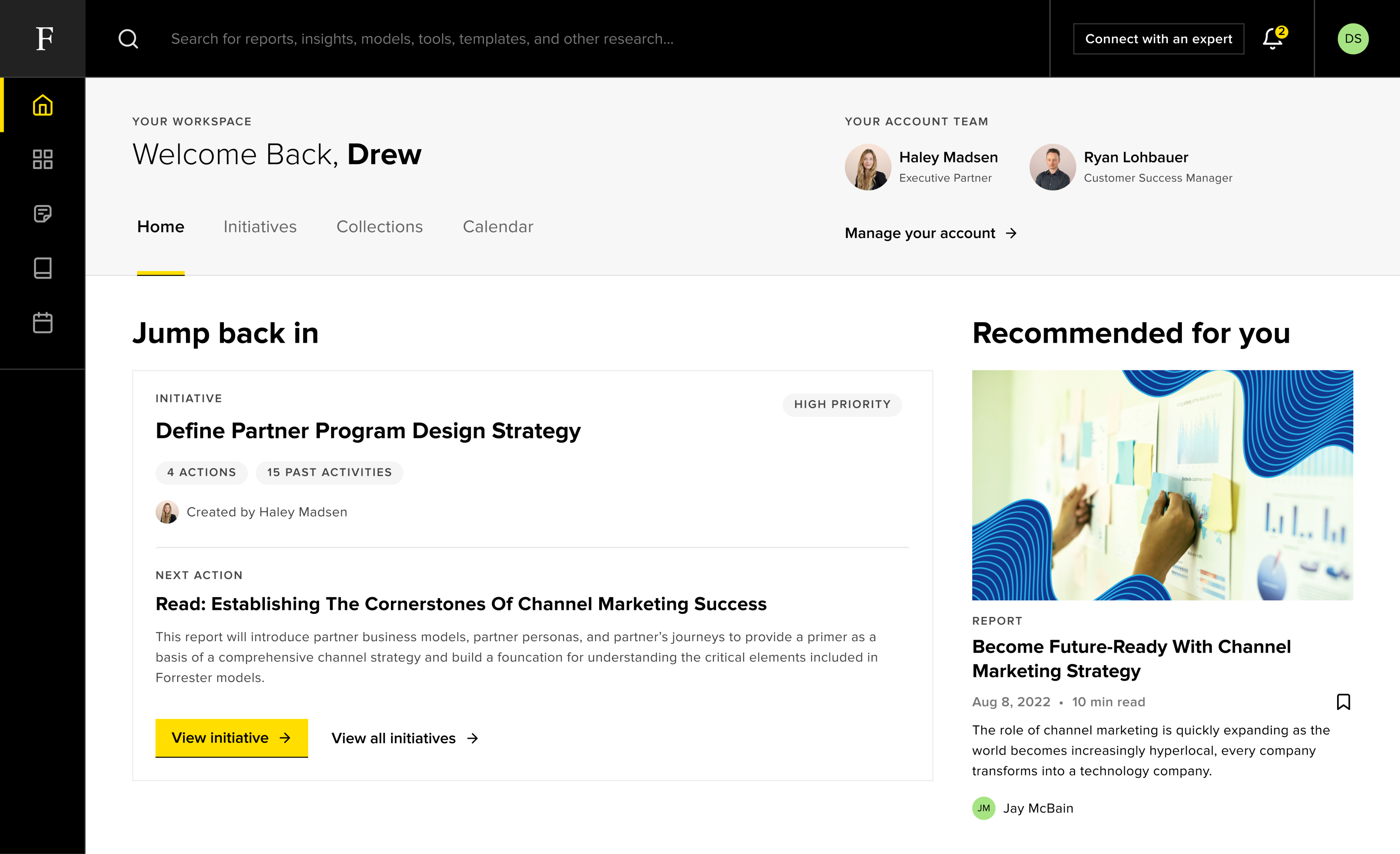
Before
Reports Were the Focus
The platform’s existing homepage put Forrester’s reports at the center of the experience.
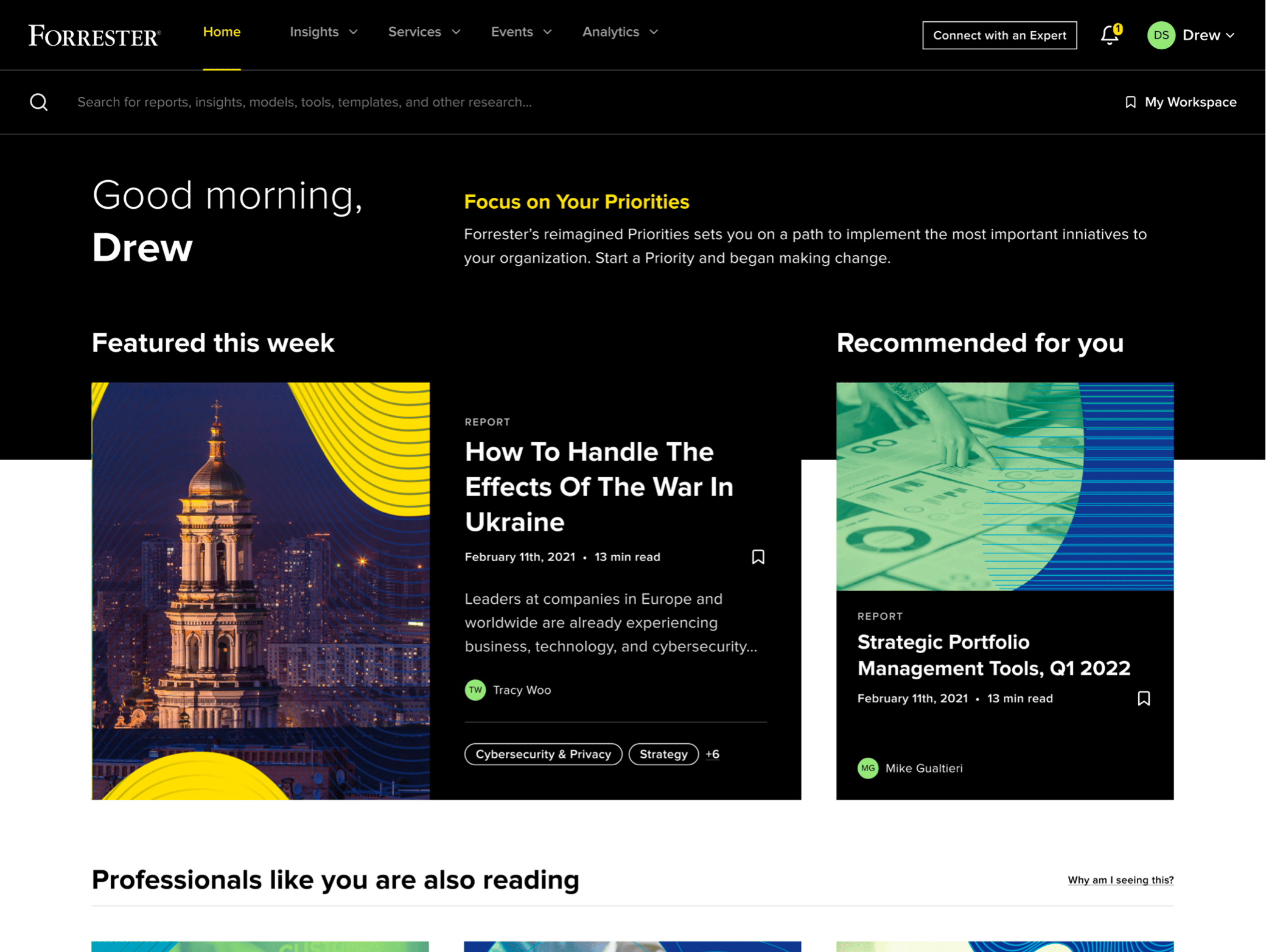
After
Reorientated Focus on Client Initiatives
The tested concept reorientated the platform’s homepage by putting the client’s initiatives at the center.
IMpact
Alignment
Unified cross-functional teams around a shared service model and vision to deliver continuous client value.
+12%
Retention rate increase via the new service model.
+3.1 Point Increase
In overall CX Index score (2022–2024), validating long-term impact.
Transforming Forrester’s Culture
This sprint introduced a new way of working for Forrester. By convening a cross-functional group in-person, I helped transform a traditionally slow decision-making culture into a more agile and collaborative one.
Following the sprint, I sent I survey to participants asking for their anonymous feedback. This is what they shared.
Feedback from the sprint team
Highly Valued
Orchestrating a Design Sprint to Align Leaders Across the Org
Achieved its Ambitious goal
Participants rated the sprint’s goal achievement a 6.6/7 when asked “To what extent do you think the sprint achieved its goal?”
Orchestrating a Design Sprint to Align Leaders Across the Org
Orchestrating a Design Sprint to Align Leaders Across the Org
"I think this effort is a huge accelerator for both client and employee experiences… The sprint itself had an ambitious goal... and was wildly successful."
“We need to do things like this more often to make rapid progress."
Created Inclusive Collaboration
Participants from Sales and Research roles reported feeling empowered to contribute creatively, breaking down the "creative vs. non-creative" divide.
"I found it very valuable to hear from and understand multiple perspectives on a single challenge."
“The sprint’s agenda and activities were extremely well planned and facilitated.”

Back
Unifying Forrester’s Service Model
I orchestrated a cross-functional design sprint to bridge the gap between high-touch analyst advisory and digital self-service, transforming a disjointed client experience into a unified, retention-driving service model.

impact
Alignment
Unified cross-functional teams around a shared service model and vision to deliver continuous client value.
+12%
Retention rate increase via the new service model.
+3.1 Point Increase
In overall CX Index score (2022–2024), validating long-term impact.
The "Invisible Value" Problem
Forrester’s primary value lies in the expert guidance that its analysts provide. However, the digital client platform acted merely as a library for reports. Clients had high-touch engagements with analysts, but the digital platform didn't build on those key moments. It also did not demonstrate the value delivered during them.
Because of this disjointed experience, clients’ perception of the value Forrester provided ebbed and flowed. The result, they engaged less frequently leading to higher churn.
We needed to transform the service model and platform to provide a more seamless experience. One in which clients could easily pick up where they left off following a conversation with one of Forrester’s analysts and take action on the guidance they were given.

Orchestrating a Design Sprint to Align Leaders Across the Org
To solve a problem this structural, I recognized we needed to convene leaders from across the organization. Gaining that level of alignment to co-create a solution required dedicated time, focus, and customer feedback.
Having successfully orchestrated Design Sprints in the past I knew applying this proven methodology from Google Ventures to our problem would help us solve it quickly.
I pitched my idea to hold a sprint to different leaders across the organization. I shared examples that demonstrated how other organizations experienced success with sprints and highlighted how it would accelerate disparate projects that were already taking place. With enough buy-in I was able to book three days in-person (for high energy co-creation) and two days remotely (for focused prototyping and testing).

Accelerating Consensus Within 48 Hours
Within the first two days, I was able to get the sprint team which consisted of stakeholders across Research, Sales, Product, and Technology to develop a shared understanding of the problem and agree on a definition of client success.By day three, the team generated a litany of solutions, but with clients scheduled for testing by the end of the week we needed to pick one final idea to prototype and test. I led a voting exercise and a concept nicknamed “The Journey To Success” was the clear winner. It was now my direct team’s responsibility to build a prototype and develop a study plan for testing with clients the following day.
During day one I shared findings from past research to form of a collective understanding of the problem.
During day two sprint participants affinity mapped “how might we” questions identifying where there were similar opportunities to solve the invisible value problem.
On day three participants reviewed each others solution sketches. They identified areas of interest using small sticky dots and then cast their final votes using large ones.
Evolving Beyond the Report and Focusing on Clients Initiatives
Testing validated that clients didn't want more reports, they wanted a research partner that could proactively guide them through their initiatives.
“I do feel like if I was moving towards an objective driven engagement that would be a benefit. That would be something new that I'm not currently doing with Forrester. I’m doing it, but it’s not organized in that way.”
– VP of Marketing at a Technology Company
This breakthrough and validation from clients created a unified vision for how we could transform our service model and enhance our digital platform. Putting our clients’ initiatives at the center was the answer.
When an analyst advises a client, we would build on that key moment. A client would be notified via email that their dashboard (a new area of the digital platform) was updated with that analyst’s guidance. This created a more connected client experience that bridged the former human and digital divide.
Before
Reports Were the Focus
The platform’s existing homepage put Forrester’s reports at the center of the experience.
After
Reorientated Focus on Client Initiatives
The tested concept reorientated the platform’s homepage by putting the client’s initiatives at the center.
Orchestrating a Design Sprint to Align Leaders Across the Org
By reorienting the service model around client needs, their initiatives and outcomes, we contextualized Forrester's research and expert guidance. This shift proved that operationalizing Customer Obsession, the very methodology Forrester’s own analysts pioneered, directly correlates with higher retention. The sprint was the catalyst behind this longer term transformation. It established the vision for what would later result in increased client satisfaction (as demonstrated by our CX Index score) as well as a 12% increase in retention.
IMpact
Alignment
Unified cross-functional teams around a shared service model and vision to deliver continuous client value.
+12%
Retention rate increase via the new service model.
+3.1 Point Increase
In overall CX Index score (2022–2024), validating long-term impact.
Transforming Forrester’s Culture
This sprint introduced a new way of working for Forrester. By convening a cross-functional group in-person, I helped transform a traditionally slow decision-making culture into a more agile and collaborative one.
Following the sprint, I sent I survey to participants asking for their anonymous feedback. This is what they shared.
Feedback from the sprint team
Highly Valued
Orchestrating a Design Sprint to Align Leaders Across the Org
Achieved its Ambitious goal
Participants rated the sprint’s goal achievement a 6.6/7 when asked “To what extent do you think the sprint achieved its goal?”
Orchestrating a Design Sprint to Align Leaders Across the Org
Orchestrating a Design Sprint to Align Leaders Across the Org
"I think this effort is a huge accelerator for both client and employee experiences… The sprint itself had an ambitious goal... and was wildly successful."
“We need to do things like this more often to make rapid progress."
Created Inclusive Collaboration
Participants from Sales and Research roles reported feeling empowered to contribute creatively, breaking down the "creative vs. non-creative" divide.
"I found it very valuable to hear from and understand multiple perspectives on a single challenge."
“The sprint’s agenda and activities were extremely well planned and facilitated.”

Back
Unifying Forrester’s Service Model
I orchestrated a cross-functional design sprint to bridge the gap between high-touch analyst advisory and digital self-service, transforming a disjointed client experience into a unified, retention-driving service model.

impact
Alignment
Unified cross-functional teams around a shared service model and vision to deliver continuous client value.
+12%
Retention rate increase via the new service model.
+3.1 Point Increase
In overall CX Index score (2022–2024), validating long-term impact.
The "Invisible Value" Problem
Forrester’s primary value lies in the expert guidance that its analysts provide. However, the digital client platform acted merely as a library for reports. Clients had high-touch engagements with analysts, but the digital platform didn't build on those key moments. It also did not demonstrate the value delivered during them.
Because of this disjointed experience, clients’ perception of the value Forrester provided ebbed and flowed. The result, they engaged less frequently leading to higher churn.
We needed to transform the service model and platform to provide a more seamless experience. One in which clients could easily pick up where they left off following a conversation with one of Forrester’s analysts and take action on the guidance they were given.

Orchestrating a Design Sprint to Align Leaders Across the Org
To solve a problem this structural, I recognized we needed to convene leaders from across the organization. Gaining that level of alignment to co-create a solution required dedicated time, focus, and customer feedback.
Having successfully orchestrated Design Sprints in the past I knew applying this proven methodology from Google Ventures to our problem would help us solve it quickly.
I pitched my idea to hold a sprint to different leaders across the organization. I shared examples that demonstrated how other organizations experienced success with sprints and highlighted how it would accelerate disparate projects that were already taking place. With enough buy-in I was able to book three days in-person (for high energy co-creation) and two days remotely (for focused prototyping and testing).
Accelerating Consensus Within 48 Hours
Within the first two days, I was able to get the sprint team which consisted of stakeholders across Research, Sales, Product, and Technology to develop a shared understanding of the problem and agree on a definition of client success.By day three, the team generated a litany of solutions, but with clients scheduled for testing by the end of the week we needed to pick one final idea to prototype and test. I led a voting exercise and a concept nicknamed “The Journey To Success” was the clear winner. It was now my direct team’s responsibility to build a prototype and develop a study plan for testing with clients the following day.
During day one I shared findings from past research to form of a collective understanding of the problem.
During day two sprint participants affinity mapped “how might we” questions identifying where there were similar opportunities to solve the invisible value problem.
On day three participants reviewed each others solution sketches. They identified areas of interest using small sticky dots and then cast their final votes using large ones.
Evolving Beyond the Report and Focusing on Clients Initiatives
Testing validated that clients didn't want more reports, they wanted a research partner that could proactively guide them through their initiatives. Onc client shared:
“I do feel like if I was moving towards an objective driven engagement that would be a benefit. That would be something new that I'm not currently doing with Forrester. I’m doing it, but it’s not organized in that way.”
– VP of Marketing at a Technology Company
This breakthrough and validation from clients created a unified vision for how we could transform our service model and enhance our digital platform. Putting our clients’ initiatives at the center was the answer.
When an analyst advises a client, we would build on that key moment. A client would be notified via email that their dashboard (a new area of the digital platform) was updated with that analyst’s guidance. This created a more connected client experience that bridged the former human and digital divide.
Before
Reports Were the Focus
The platform’s existing homepage put Forrester’s reports at the center of the experience.
After
Reorientated Focus on Client Initiatives
The tested concept reorientated the platform’s homepage by putting the client’s initiatives at the center.
The Impact of Operationalizing Customer Obsession
By reorienting the service model around client needs, their initiatives and outcomes, we contextualized Forrester's research and expert guidance. This shift proved that operationalizing Customer Obsession, the very methodology Forrester’s own analysts pioneered, directly correlates with higher retention. The sprint was the catalyst behind this longer term transformation. It established the vision for what would later result in increased client satisfaction (as demonstrated by our CX Index score) as well as a 12% increase in retention.
IMpact
Alignment
Unified cross-functional teams around a shared service model and vision to deliver continuous client value.
+12%
Retention rate increase via the new service model.
+3.1 Point Increase
In overall CX Index score (2022–2024), validating long-term impact.
Transforming Forrester’s Culture
This sprint introduced a new way of working for Forrester. By convening a cross-functional group in-person, I helped transform a traditionally slow decision-making culture into a more agile and collaborative one.
Following the sprint, I sent I survey to participants asking for their anonymous feedback. This is what they shared:
Feedback from the sprint team
Highly Valued
Participants rated the sprint’s value a 6.8/7 when asked “How valuable did you find the design sprint?”
Achieved its Ambitious goal
Participants rated the sprint’s goal achievement a 6.6/7 when asked “To what extent do you think the sprint achieved its goal?”
Accelerated Alignment
Participants validated that the sprint format broke down silos and aligned the team faster than traditional methods.
"I think this effort is a huge accelerator for both client and employee experiences… The sprint itself had an ambitious goal... and was wildly successful."
“We need to do things like this more often to make rapid progress."
Created Inclusive Collaboration
Participants from Sales and Research roles reported feeling empowered to contribute creatively, breaking down the "creative vs. non-creative" divide.
"I found it very valuable to hear from and understand multiple perspectives on a single challenge."
“The sprint’s agenda and activities were extremely well planned and facilitated.”